On our last day in Seville we were met by Chef Ana Lopez who has a cooking school located not far from our hotel in the old part of Seville. We had arranged in advance for Ana to teach us how to make salmorejo, a traditional Andalusian soup made with tomato, bread, olive oil and garlic. Salmorejo is typically served cold with diced hard-boiled egg and Iberico ham. We also arranged for Ana to teach us to make paella con mariscos, (paella with seafood).
First, Ana took us to the local market to purchase tomatoes, bread, shrimp, clams and mussels.
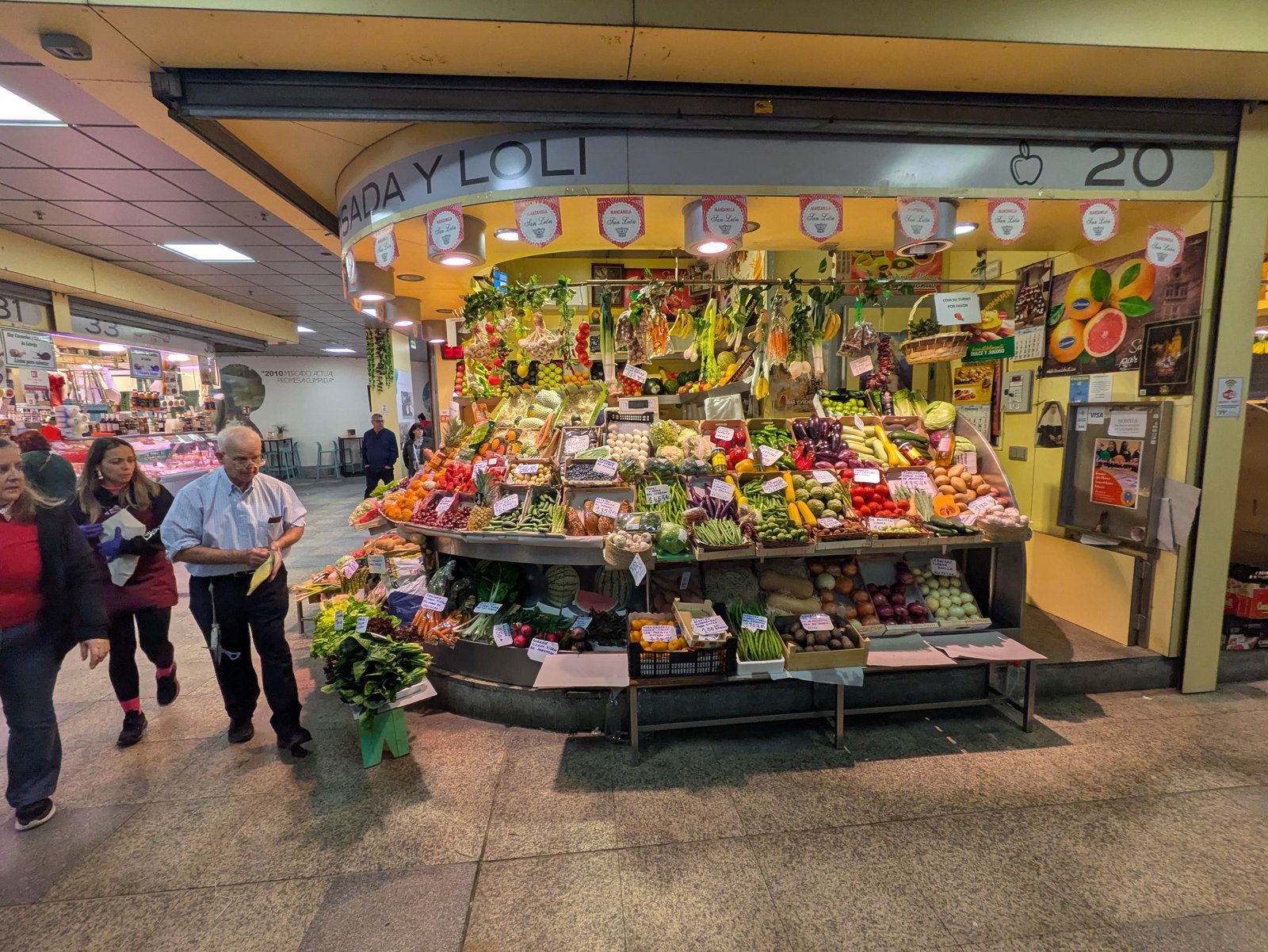 Shopping for fruits and veggies at the market.
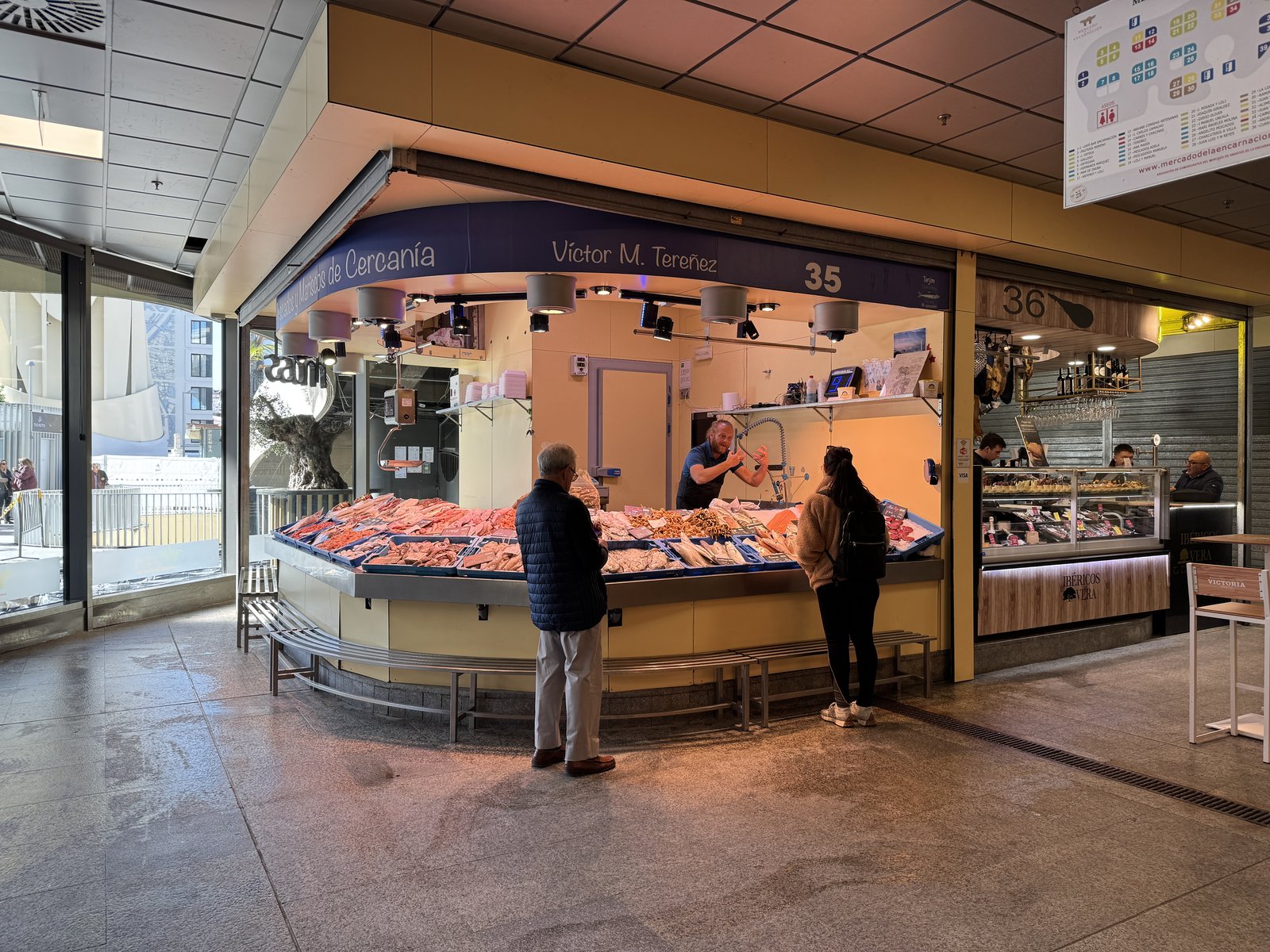 The fish vendor at the market.
Ana also gave us a primer on Iberian ham (also known as jamon serrano). The ham from the black Iberian pigs fed on acorns is the highest quality and therefore the most expensive. Then you have to choose between the back leg and the shoulder (front leg). Ana prefers the shoulder fed on pure acorns. I tried a couple of different types and they both tasted great to me.
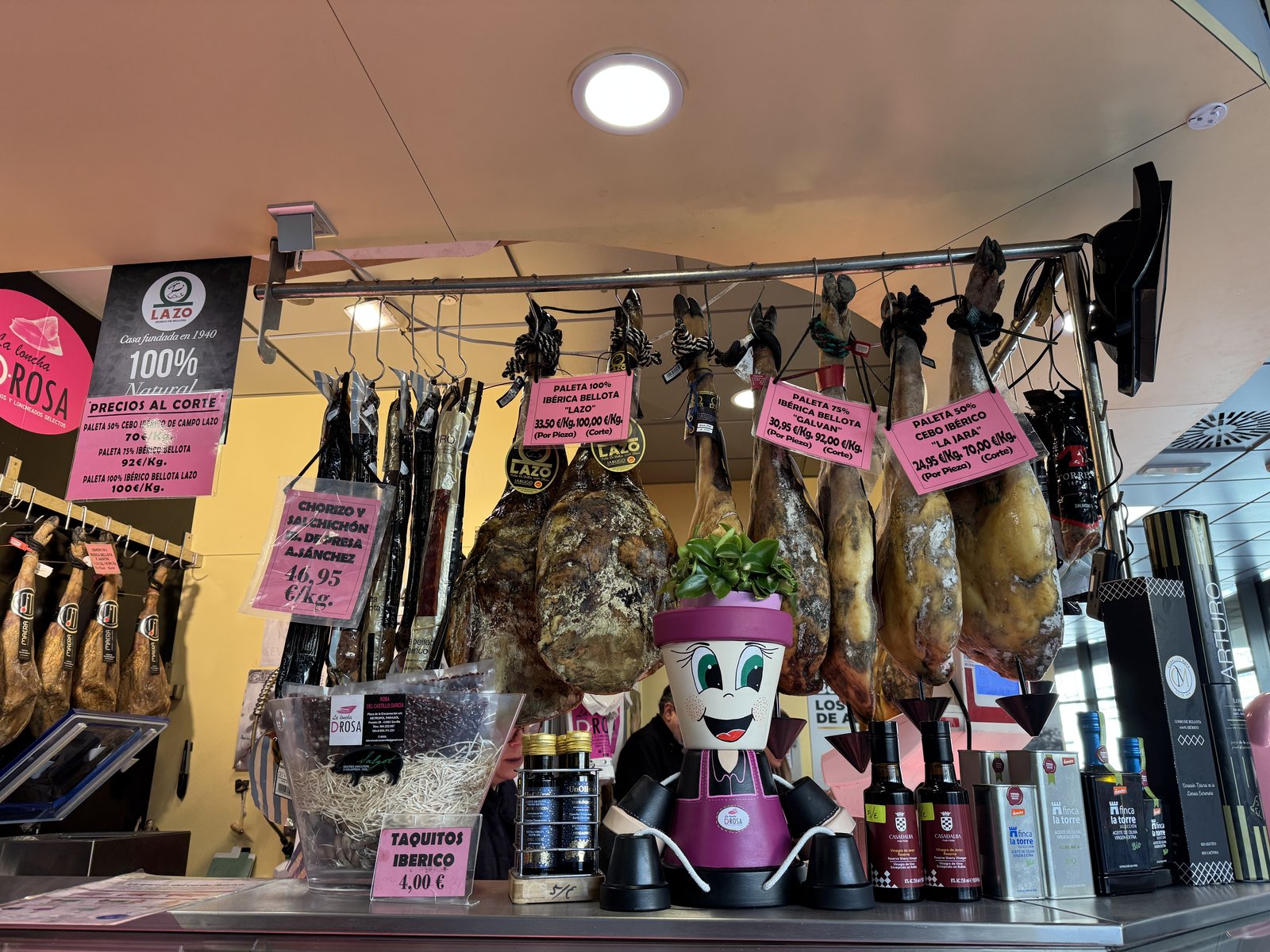 The ham vendor at the market.
Armed with our groceries, we repaired to Ana's cooking school where we would learn how to make salmorejo and paella con mariscos. To make the salmorejo we cut up Roma tomatoes and pureed them in a blender, strained the tomatoes, put them back in the blender, added a bit of diced garlic and some hand-shredded bread, and blended until it was very thick with no lumps. With the blender running we added about a half cup of olive oil in a fine stream. Then into the freezer for about half an hour before serving with chopped hard boiled egg and diced ham.
For the paella we diced onion, garlic and red pepper and cooked them for about 10 minutes in the paella pan over medium low heat (this is called the sofrito). Meanwhile we took the heads and shells off of the shrimp and boiled those in two cups of water for about 10 minutes. We used a hand blender to break up the shrimp heads and shells in their cooking water, and we strained that water to use as a broth to cook the paella rice. We boiled the mussels and clams until they opened and set them aside too. Then we added the rice to the pan (along with the sofrito) and the strained shrimp broth plus a bit more water (Ana recommends a ratio of 123: 1 part rice to 3 parts water by weight) and allowed the rice to cook in the paella pans for about 18 minutes or so. When the rice began to sizzle slightly and emit some snap, crackle and pop sounds, it was time to turn off the heat, add the already cooked seafood to the top of the rice without disturbing the rice, cover with paper towels and allow the paella to finish cooking and rest for 15 minute or so.
After the cooking was complete we went out onto Ana's beautiful outdoor terrace and ate the salmorejo as a first course followed by the paella as the main course. 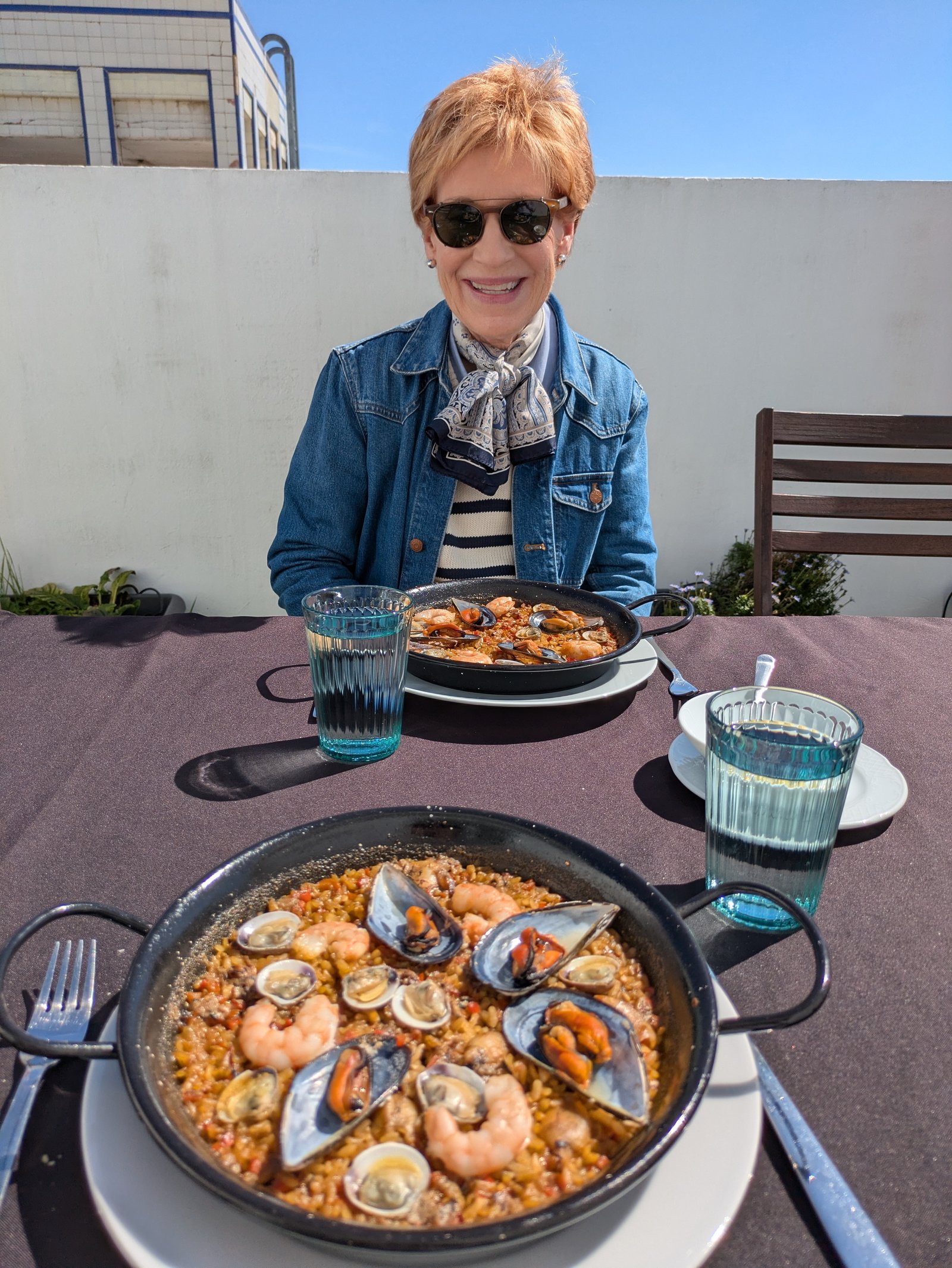
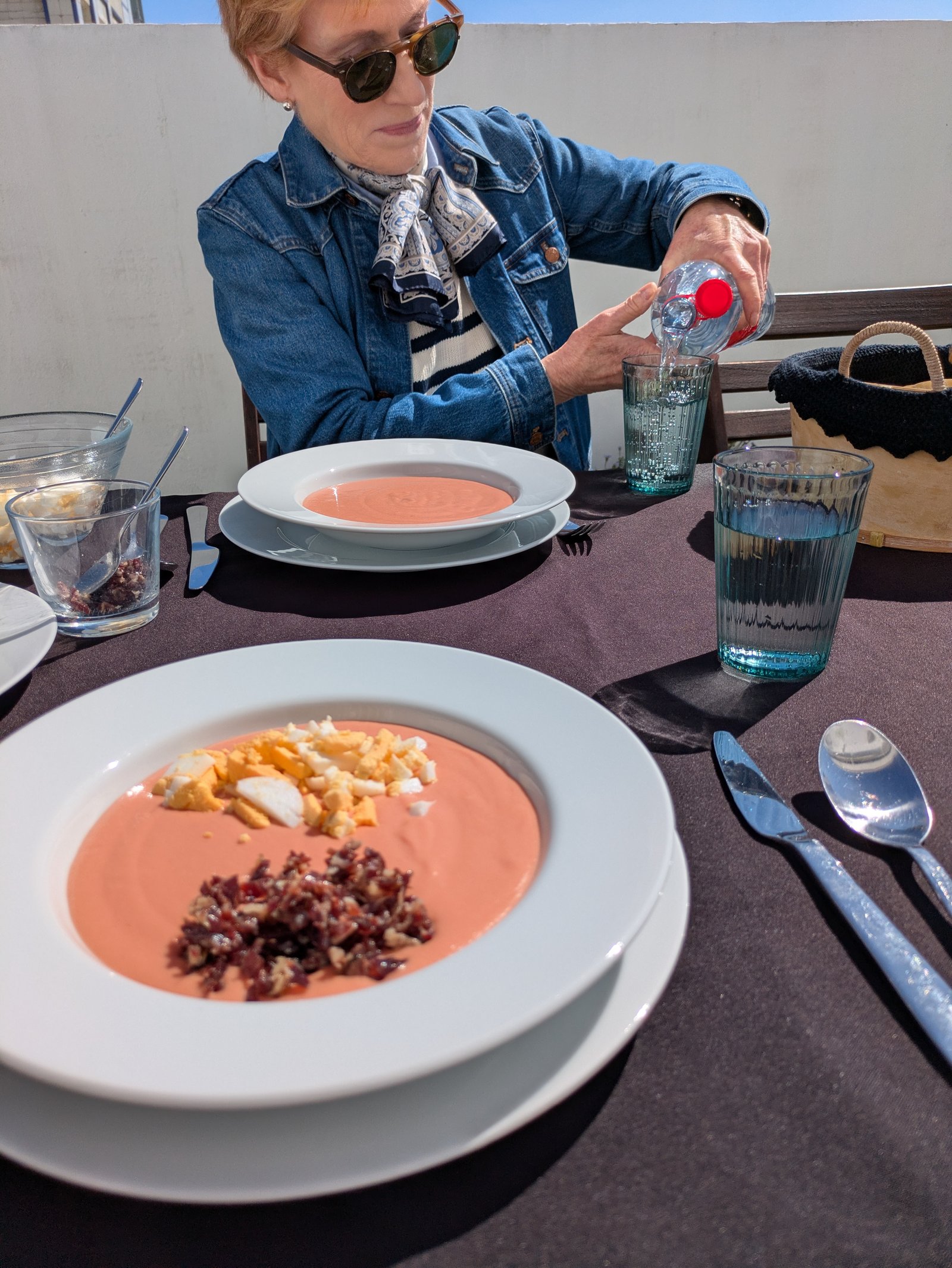 Both dishes were out of this world, especially the paella. Cath and I declared the paella as the best we've ever eaten. And we've eaten quite a bit of paella! As many readers of this blog know, I've cooked quite a few paellas in my time but maybe I should have come to Ana's school 30 or so years earlier. Now that I've taken Ana's class I feel I'm ready to really make some great paella. So get ready! And maybe we will start the meal with some salmorejo!
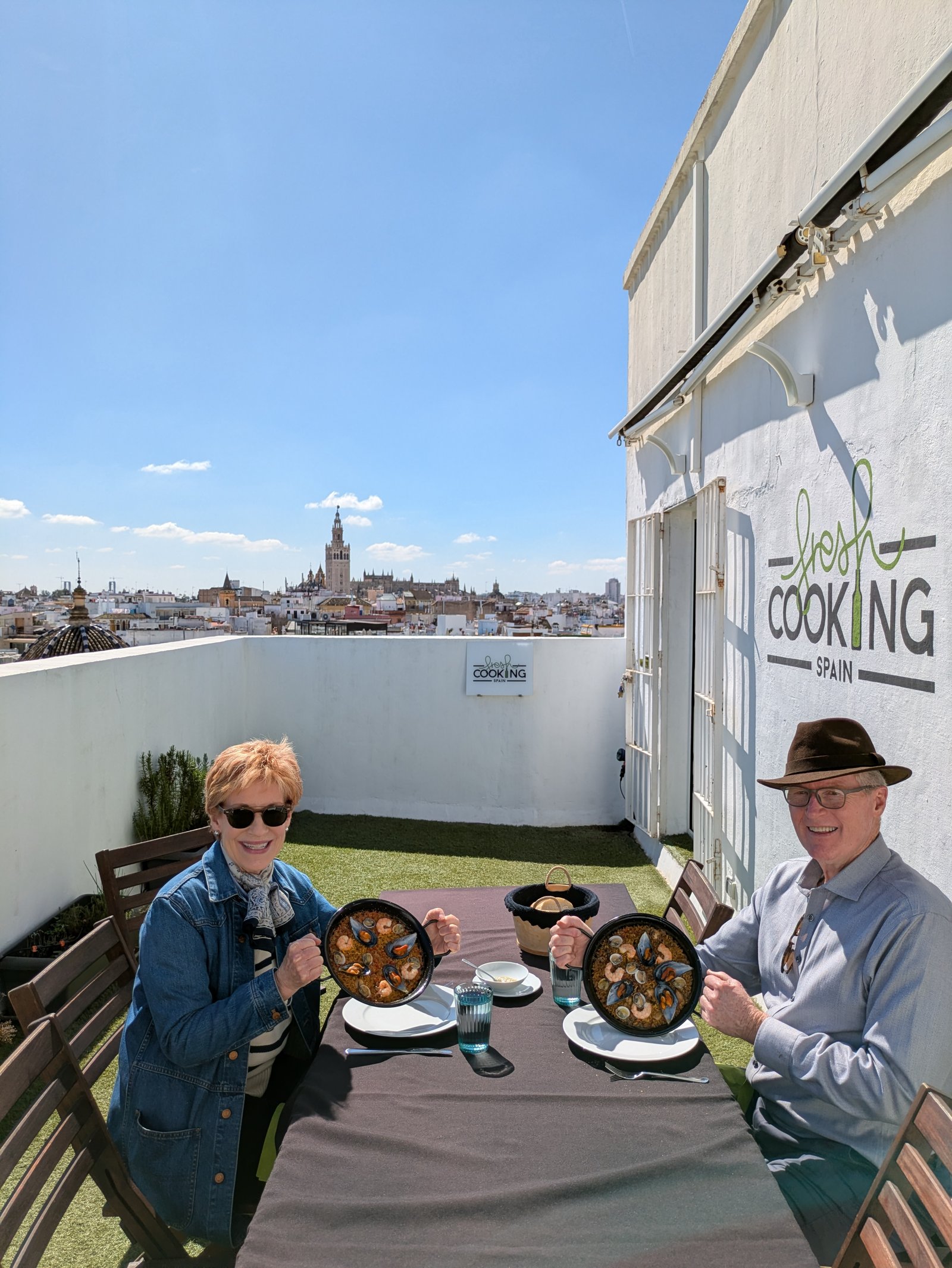
For anyone who is interested in the recipes leave a comment below and I will email them to you. I won't post the exact recipe here out of respect for Ana's original recipes which she was kind enough to give to us.
When we left Ana's cooking school we were in a bit of a food daze, but we gathered ourselves sufficiently to head over to El Corte Ingles, which is Spain's equivalent to all of the great U.S. department stores that no longer exist. Let's say it's like Macy's in its prime. It's the store that has everything: clothing, luggage, groceries, fish and meat market, stationery, cafes, a beautiful rooftop terrace. If you need something, the Corte Ingles will probably have it. We had asked Ana where we should buy some authentic Spanish La Mancha saffron and she replied instantly "El Corte Ingles". So we headed over there and found our saffron, along with a few other tourist souvenirs like genuine Seville orange marmalade. Then it was back to the hotel for a little recharge and blogging time.
For dinner we intended to go to a nice little bar/restaurant called Compte but it wasn't open so we just took a walk wandering around the old city to see what we could see. Improbably, we happened upon an Italian pizza place called "Sesto Gusto", which is the first "foreign" location for an Italian restaurant located in Turin, Italy. To me, being a total pizza fanatic, this is a "must visit" restaurant. One of the best pizzas either of us have ever tasted. It can't quite top my favorite place in Costa Mesa, Folks Pizzeria, but it's really great. According to the restaurant's website, the founder believes the "sixth taste" is “the sensitivity of the mouth to the taste of carbohydrates. In other words, what makes us feel a great love for pizza, bread and all the wheat-based doughs." So now I have a scientific name for my pizza and bread obsession.
After dinner we decided to go try an ice cream place recommended to us by our cooking teacher Ana: Rayas, and it was right up there with the many gelaterias we visited in Italy a couple of years back. I had hazelnut and coffee (both excellent) and Cath had a combo of Turron (nougat) and caramel cream, which she thought was a bit on the sweet side but highly edible. 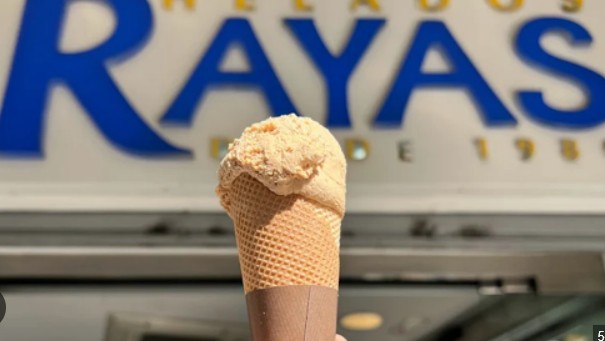
So ended one of our biggest food days while in Spain.
As attentive readers will probably have realized, I have fallen a bit behind on timely publication of our travel experiences. Sometimes having fun takes precedence over putting fingers to keyboard. As I write this, our cooking class in Sevilla was about a week ago and therefore at the time of publication of this post (March 17), tomorrow morning we will board a plane to return home to Orange County, CA. So I haven't yet recounted our trip from Sevilla to Evora, Portugal, nor our experiences in and around the Alentejo region of southern Portugal (a really beautiful area). 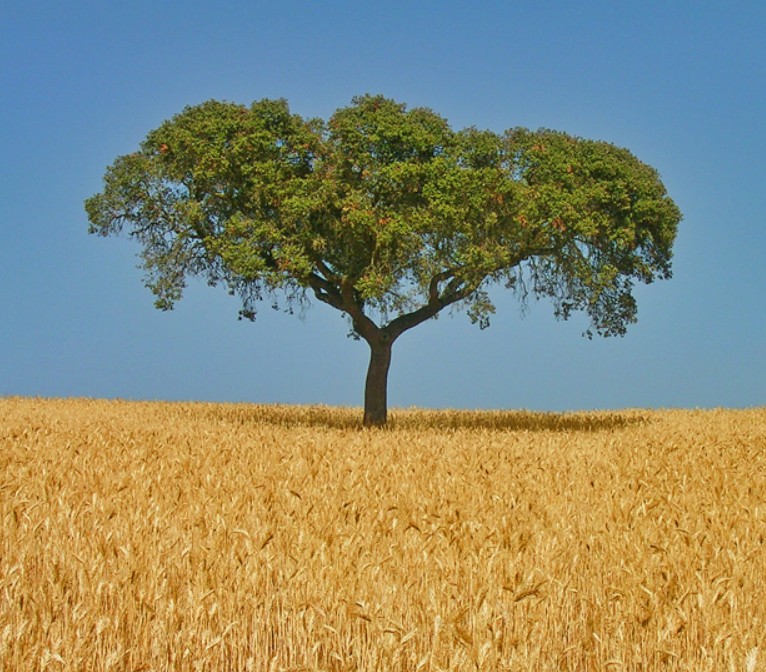
We've really enjoyed the wonderful people of Spain and Portugal, their vibrant cultures and delicious cuisines. We would love to come back here again. Thanks for following along with us. We hope you have enjoyed reading the blog.
¡ Hasta la vista!
Comments (8)
Thanks for sharing your memories with us! Please do share the Paella recipe, we could have a cook off!
Welcome home.
Thanks so much for sharing your adventures with us!
Thanks Ben, it was my pleasure! We have to get you blogging next time you go on one of your trips!
Sounds like the cooking class in Sevilla was great!
Some day [hopefully soon...] I look forward to seeing if your Paella compares to what my mom used to make.
Saludos!
Ramonsito
I am SOOOOOOO jealous after seeing your cooking class day! Everything looked amazing, from the market to the final plating. Wow!
fantastic, dear travelers!
bon voyage and thanks for amazing reports of an amazing trip!!
the FOOD!
luv,
jfi
Jim, gracias Muchissimas for sharing your experiences! Of course there’s no keeping up w the richness of daily adventures! It’s about your delights surprises new learnings of history tastes present & old cultures … no way to document fully if you want to experience completely! Loved every one of your posts — generous of you to share! Wish you a very safe smooth travel back home. ❤️🙏
Thanks Beth for following along and being so supportive! See you soon!